Base Exchange Rate Cross Exchange Rate:What is the difference between base exchange rate and cross exchange rate?
Q: What is the difference between base exchange rate and cross exchange rate?
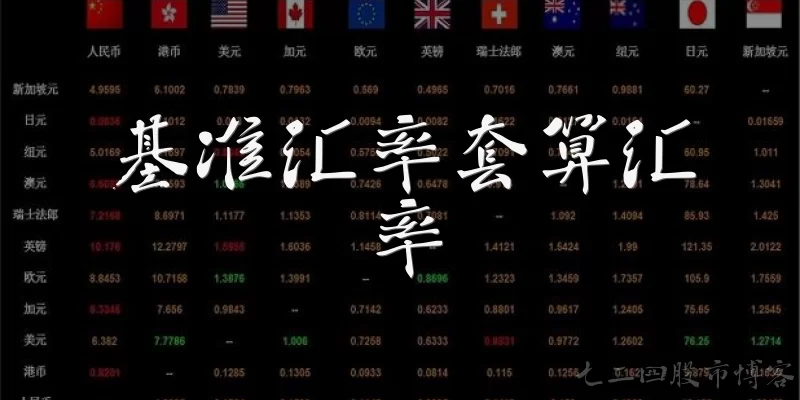
A: The base exchange rate and cross exchange rate serve different purposes in currency markets. A base exchange rate is the value of one currency expressed relative to a base currency, typically the US dollar, serving as the primary reference point for most global transactions. It's the direct quote you see for major pairs like EUR/USD or USD/JPY. A cross exchange rate, on the other hand, is the rate between two currencies where neither is the base currency of the quoting party. For example, if you want to convert euros to Japanese yen, the EUR/JPY rate is a cross rate because it doesn't directly involve the US dollar. Cross rates are derived by combining two base rates, such as EUR/USD and USD/JPY, to eliminate the dollar. The key difference is that base rates are primary and directly quoted in the market, while cross rates are secondary and calculated. Understanding this distinction is crucial for forex traders, international businesses, and travelers who need accurate currency conversions without always going through the dollar.
Q: How do you calculate a cross exchange rate using base exchange rates?
A: Calculating a cross exchange rate involves using two base exchange rates that share a common currency, usually the US dollar. The formula depends on the direction of the quotes. Suppose you have the base rate for EUR/USD (how many dollars per euro) and USD/JPY (how many yen per dollar). To find the EUR/JPY cross rate (how many yen per euro), you multiply the two rates: EUR/JPY = EUR/USD × USD/JPY. For example, if EUR/USD = 1.10 and USD/JPY = 150, then EUR/JPY = 1.10 × 150 = 165 yen per euro. If the common currency is in the denominator of one rate and the numerator of the other, multiplication works. However, if both rates have the common currency in the denominator, such as USD/EUR and USD/GBP, you divide instead: EUR/GBP = USD/GBP ÷ USD/EUR. Always ensure the common currency cancels out. This method allows traders to derive any cross rate from liquid base pairs, enabling arbitrage and pricing efficiency in the forex market.
Q: Why are cross exchange rates important in international trade and finance?
A: Cross exchange rates are vital in international trade and finance because they allow direct currency conversion without relying on the US dollar as an intermediary. In a global economy, businesses and investors frequently need to exchange currencies that are not directly traded against each other. For instance, a Japanese company importing from Switzerland may need to convert yen to Swiss francs. Instead of converting yen to dollars and then dollars to francs, a bank can use the CHF/JPY cross rate to execute a single transaction, reducing costs and exchange rate risk. Cross rates also enhance market efficiency by enabling arbitrage opportunities: if the calculated cross rate deviates from the actual quoted rate, traders can profit by buying and selling simultaneously. Furthermore, cross rates provide liquidity in less-traded currency pairs, as they are derived from highly liquid base pairs. For multinational corporations, accurate cross rates are essential for pricing, hedging, and financial reporting. Ultimately, they facilitate smoother international transactions and integrate global currency markets.
Dialogue about
Common scenarios of "Base Exchange Rate Cross Exchange Rate"
【Customer】 Hi, I have a question about exchange rates. I'm traveling to Europe soon and I'm a bit confused about base exchange rates and cross exchange rates. Can you explain?
【Bank Teller】 Of course! I'd be happy to help. The base exchange rate is the rate at which one currency is exchanged for another. For example, if you're in the US and want to buy euros, the base exchange rate might be 1 USD = 0.85 EUR. That's the direct rate.
【Customer】 So if I want to exchange USD to EUR, I would use that rate? But what is cross exchange rate then?
【Bank Teller】 Exactly. The cross exchange rate comes into play when you exchange between two currencies that are not the official currencies of the country where you are. For instance, if you are in the US and want to exchange British pounds to Japanese yen, you would use the cross rate, which is derived from the USD/GBP and USD/JPY rates.
【Customer】 I see. So how do you calculate the cross rate? Is it just multiplying or dividing?
【Bank Teller】 It depends on how the rates are quoted. If both currencies are quoted against the USD as base, you would divide the two rates. For example, if USD/GBP = 0.75 and USD/JPY = 110, then GBP/JPY = 110 / 0.75 = 146.67. That means 1 GBP = 146.67 JPY.
【Customer】 Okay, so if I have 100 GBP, I would get 14,667 JPY? That seems like a lot.
【Bank Teller】 Yes, that's correct, but remember that exchange rates fluctuate and banks charge fees or have different rates. Also, the actual rate you get might include a spread.
【Customer】 What's a spread?
【Bank Teller】 The spread is the difference between the rate at which the bank buys and sells a currency. It's how they make a profit. So the rate you see online might not be the exact rate you get when you exchange money.
【Customer】 Got it. So when I exchange USD to EUR, I use the base rate, but if I exchange EUR to JPY, I use the cross rate? But I'm in the US, so how would I get JPY?
【Bank Teller】 If you're in the US and want to exchange EUR to JPY, you would first need to convert EUR to USD using the base rate (EUR/USD), then USD to JPY using the base rate (USD/JPY). Alternatively, the bank might quote you a direct EUR/JPY cross rate, which is calculated from those two.
【Customer】 So the cross rate is just a combination of two base rates? That makes sense.
【Bank Teller】 Exactly. It's a derived rate. And it's useful for international trade and travel when you need to exchange currencies that aren't directly traded.
【Customer】 Are cross rates always calculated the same way? What if the quotes are in different terms?
【Bank Teller】 Good question. Sometimes quotes are indirect, like JPY/USD instead of USD/JPY. In that case, you might need to invert one rate before multiplying or dividing. It's important to check the quotation convention.
【Customer】 That sounds complicated. Is there a simple rule to remember?
【Bank Teller】 A common rule is: if the two currencies share the same base currency, divide the rates. If they share the same quote currency, multiply the rates. But it's best to use a reliable converter or ask your bank.
【Customer】 Thanks, that helps a lot. I think I'll just use my bank's online converter to avoid mistakes.
【Bank Teller】 That's a wise choice. And don't forget to check for fees and the current rate before you exchange. Have a great trip!