Futures Market Closing Review:What is a futures market closing review?
Q: What is a futures market closing review?
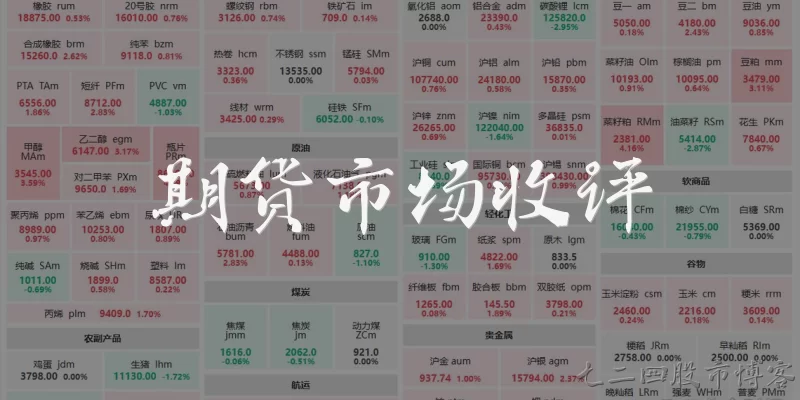
A: A futures market closing review is a daily summary and analysis of trading activity that occurs after the market closes. It typically covers major futures contracts such as crude oil, gold, treasury bonds, and stock index futures. The review includes closing prices, price changes, trading volume, open interest, and key factors that influenced the session. Analysts use this review to explain why prices moved, highlight significant events, and provide a forward-looking perspective. It serves traders, investors, and financial media by consolidating essential market data into a concise report, helping stakeholders understand the day's performance and prepare for the next trading session.
Q: Why is the closing review important for futures traders?
A: The closing review is important because it gives traders a complete picture of the trading day after the closing bell. It consolidates price movements, volume, and open interest changes across various contracts, helping traders identify trends, reversals, and support or resistance levels. By summarizing the key drivers—such as economic data, geopolitical events, or inventory reports—it provides context that intraday trading may miss. This review also helps traders assess market sentiment and adjust their strategies for the next session. Without it, traders would have to manually track multiple data points, increasing the risk of overlooking critical information that affects their positions.
Q: What key data points are included in a futures market closing review?
A: A typical futures market closing review includes several key data points. First, settlement prices for major contracts, along with daily price changes in absolute and percentage terms. Second, trading volume and open interest, which indicate market activity and commitment. Third, the day's high, low, and settlement range. Fourth, sector performance, such as energy, metals, agriculture, and financials. Fifth, relevant news or economic indicators that influenced the market, like inventory data, central bank statements, or geopolitical developments. Finally, technical levels and analyst commentary may be included to provide insight into potential future movements. These elements together offer a comprehensive snapshot of the futures market.
Q: How does a closing review differ from an intraday market update?
A: A closing review differs from an intraday update primarily in timing and scope. Intraday updates are released during trading hours, often multiple times a day, and focus on immediate price action, breaking news, and short-term trends. They are quick, concise, and aimed at active traders. In contrast, a closing review is published after the market closes and provides a comprehensive summary of the entire session. It includes final settlement prices, total volume, open interest changes, and a retrospective analysis of what drove the market. It also often includes forward-looking commentary for the next session, while intraday updates are more reactive and less analytical.
Q: What are common sources for a futures market closing review?
A: Common sources for a futures market closing review include major financial news outlets like Bloomberg, Reuters, and CNBC, which publish daily summaries after the close. Exchange websites such as CME Group, ICE, and Eurex also provide official closing data and reports. Brokerage firms often distribute their own closing reviews to clients, adding proprietary analysis. Additionally, specialized market research platforms and financial data providers like FactSet and Refinitiv offer detailed closing reviews. Social media and trading forums may also share summaries, but these are less reliable. For accuracy, traders typically rely on a combination of official exchange data and reputable financial news sources.
Words of experience
Common scenarios of "Futures Market Closing Review"
【Host】 Good afternoon, traders and investors. Welcome to our daily futures market closing review. I'm your host, Alex. The markets have just closed, and we're here to break down today's action. Joining me are Sarah, a senior commodities analyst, and Mike, a futures trader with over a decade of experience. Welcome, both.
【Sarah】 Thanks, Alex. Good to be here.
【Mike】 Thanks, Alex. Happy to share my thoughts.
【Host】 Let's start with the overall market sentiment today. Sarah, how would you characterize the session?
【Sarah】 Overall, it was a mixed day with significant divergence across sectors. Energy futures were the standout performers, with crude oil up nearly 2% on supply concerns. Meanwhile, metals were under pressure, with gold dipping 0.5% and copper down 1.2% due to a stronger dollar.
【Host】 Mike, as a trader, what caught your eye in today's session?
【Mike】 The volatility in natural gas was impressive. It swung wildly, ending up 3.5% after a larger-than-expected draw in inventories. I saw some good momentum trades there. Also, the S&P 500 futures were relatively calm, closing flat ahead of the Fed meeting.
【Host】 Let's dig deeper into energy. Sarah, what's driving crude oil higher?
【Sarah】 Several factors: ongoing tensions in the Middle East, a weaker dollar, and OPEC+ signaling that they might extend production cuts. The EIA report showed a smaller build in crude inventories than anticipated, which added to the bullish sentiment.
【Host】 Mike, how are you positioning yourself in energy ahead of the OPEC+ meeting?
【Mike】 I'm cautiously long crude oil but with tight stops. The market is pricing in an extension of cuts, so any disappointment could lead to a sharp sell-off. I'm also watching the spread between WTI and Brent; it's been narrowing, which might present arbitrage opportunities.
【Host】 Turning to metals, gold has been under pressure. Sarah, what's your outlook?
【Sarah】 Gold is facing headwinds from rising Treasury yields and a stronger dollar. However, geopolitical risks and central bank buying provide support. I think it's consolidating before the next move, which could be up if the Fed signals a pause in rate hikes.
【Host】 Mike, any trades in metals?
【Mike】 I'm short copper on expectations of weaker demand from China. The property sector there is still struggling, and inventories are rising. But I'm neutral on gold for now; it's too choppy.
【Host】 Let's touch on agriculture. Any notable moves there?
【Sarah】 Yes, grains were mixed. Corn and wheat were slightly lower on improved weather forecasts in the Midwest, while soybeans edged up on strong export sales. Overall, the sector is waiting for the USDA report next week.
【Mike】 I agree. I'm not active in ags right now, but I'm keeping an eye on soybean meal for a potential breakout.
【Host】 Finally, what key events should traders watch tomorrow?
【Sarah】 The Fed's interest rate decision and press conference are the main events. Also, the EIA natural gas storage report and weekly jobless claims. Any surprises could trigger volatility across all asset classes.
【Mike】 I'll be watching the Fed closely, especially for any hints on future policy. Also, keep an eye on the dollar index; a break above 105 could pressure commodities further.
【Host】 Thank you, Sarah and Mike, for your insights. That wraps up today's futures market closing review. Join us again tomorrow for more analysis. Have a great evening, everyone.