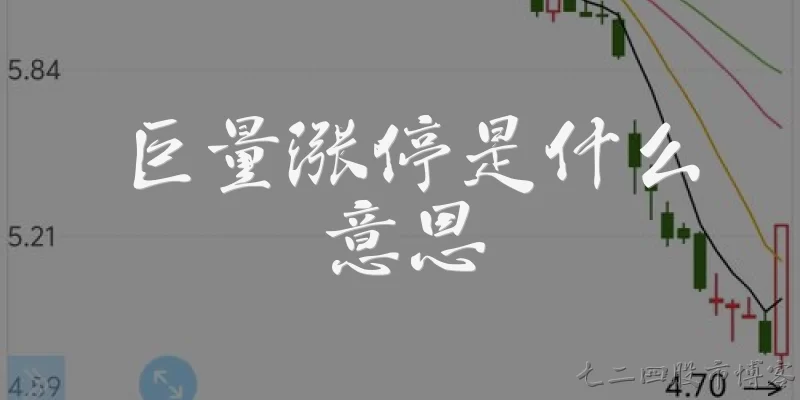
What does massive volume limit-up mean:What does massive volume limit-up mean in stock trading?
Q: What does massive volume limit-up mean in stock trading?
A: Massive volume limit-up refers to a stock hitting its daily price ceiling (limit-up) accompanied by unusually high trading volume, far exceeding its average. This signals strong buying pressure and intense market interest, often driven by positive news, sector momentum, or speculative activity. According to the SEC's Investor Bulletin on Trading Volume (2021), high volume confirms price movements, suggesting broad participation. In China, the Shanghai Stock Exchange's Trading Rules note that limit-up with massive volume may indicate a potential trend reversal or continuation, depending on context. Investors should analyze fundamentals and market sentiment to avoid chasing hype.
Q: How does massive volume limit-up differ from a normal limit-up?
A: A normal limit-up occurs when a stock rises to its daily limit with moderate or low volume, indicating limited selling pressure. In contrast, massive volume limit-up involves exceptionally high trading activity, meaning many shares changed hands at the ceiling price. The Financial Industry Regulatory Authority (FINRA) explains in its Volume and Price Movements report (2020) that high volume at a price extreme often reflects a battle between buyers and sellers, potentially signaling a climax or breakout. While normal limit-up may suggest steady demand, massive volume limit-up can indicate either strong institutional accumulation or distribution, requiring careful interpretation.
Q: What are the typical causes of massive volume limit-up?
A: Massive volume limit-up is typically caused by major news such as earnings surprises, regulatory approvals, or merger announcements, which attract a flood of buyers. The U.S. Securities and Exchange Commission (SEC) in its 'Stock Market Basics' guide (2019) notes that volume spikes often accompany material information. Additionally, sector-wide rallies, short squeezes, or retail investor mania can trigger such events. In emerging markets like China, the China Securities Regulatory Commission (CSRC) has highlighted that speculative trading and herd behavior can lead to abnormal volume at limit-up, urging investors to focus on fundamentals rather than momentum.
Q: Does massive volume limit-up indicate a bullish or bearish signal?
A: Massive volume limit-up is ambiguous and can be either bullish or bearish depending on context. According to a study by the Federal Reserve Bank of St. Louis (2022), high volume at a price high may signal a continuation if driven by strong demand, but it can also mark a climax and subsequent reversal if caused by panic buying or short covering. Technical analysts often view it as a potential exhaustion gap. Investors should examine follow-through price action, fundamentals, and market conditions. The SEC advises that volume alone is not a reliable predictor and should be used with other indicators.
Q: How should investors interpret massive volume limit-up in practice?
A: Investors should interpret massive volume limit-up cautiously by checking the underlying reason, such as news or rumors, and assessing whether the volume is sustainable. The CFA Institute's 'Technical Analysis' resource (2021) suggests comparing volume to the stock's average and analyzing price patterns. If volume is extreme but price fails to hold, it may indicate distribution. In China, the Shanghai Stock Exchange's investor education materials warn that massive volume limit-up often precedes volatility, and retail investors should avoid chasing. Always combine with fundamental analysis and risk management, as recommended by the SEC's investor.gov.
Dialogue about
Common scenarios of "What does massive volume limit-up mean"
【Novice Investor】 Hey, I've been hearing the term 'massive volume limit-up' a lot lately. What does it actually mean?
【Experienced Trader】 Great question! 'Massive volume limit-up' refers to a stock hitting its daily price limit (usually up 10% for most A-shares) with exceptionally high trading volume. It means the stock is in high demand and many shares are being traded.
【Novice Investor】 So it's just a stock that went up a lot with a lot of trading? Why is that significant?
【Experienced Trader】 It's significant because it often signals strong momentum. When a stock hits limit-up with huge volume, it indicates that buyers are very aggressive and sellers are few, which could lead to further gains. But it can also be a sign of a potential reversal if it's driven by speculation.
【Novice Investor】 What causes massive volume on a limit-up day?
【Experienced Trader】 Several factors: positive news like earnings surprises, sector-wide rallies, or rumors. Sometimes it's due to institutional buying or short covering. Also, if the stock was previously oversold, a rebound can trigger heavy volume.
【Novice Investor】 Is it a buy signal?
【Experienced Trader】 Not necessarily. It depends on the context. If it's accompanied by strong fundamentals and positive news, it might be a buy. But if it's purely speculative, it could be a trap. Always do your research.
【Novice Investor】 Can you give an example?
【Experienced Trader】 Sure. Imagine a tech company that announces a breakthrough product. The next day, the stock opens and quickly hits the 10% limit-up with volume 5 times the average. That's massive volume limit-up. Traders see it as a strong bullish signal.
【Novice Investor】 What happens after such an event? Does it continue to rise?
【Experienced Trader】 Often it does in the short term, but not always. Sometimes it pulls back as early buyers take profits. The key is to watch the follow-through volume and price action. If it consolidates and then breaks higher, it's a good sign.
【Novice Investor】 Are there any risks?
【Experienced Trader】 Absolutely. If the volume is driven by day traders or hype, it can reverse quickly. Also, if the limit-up is due to a one-time event, the stock might drop once the news is digested. Always set stop-losses.
【Novice Investor】 How can I identify a genuine massive volume limit-up?
【Experienced Trader】 Look at the news, the company's fundamentals, and the overall market sentiment. Check if the volume is sustainable and if there are institutional buyers. Also, compare the volume to the stock's average volume over the past weeks.
【Novice Investor】 Is it different from a normal limit-up?
【Experienced Trader】 Yes, a normal limit-up might have low volume if there are few sellers. Massive volume means high participation, which often indicates a stronger move. But it can also mean a lot of disagreement between buyers and sellers.
【Novice Investor】 Thanks! That's really helpful. I'll be more cautious now.
【Experienced Trader】 You're welcome! Remember, volume is a key indicator, but always combine it with other analysis. Happy investing!