Dark Horse Wave Limit-Up King:What is the 'Dark Horse Wave Limit-Up King' in the context of China's stock market?
Q: What is the 'Dark Horse Wave Limit-Up King' in the context of China's stock market?
A: The term 'Dark Horse Wave Limit-Up King' is not an official regulatory or exchange-defined concept, but rather informal market slang used by retail investors to describe a stock that unexpectedly surges with consecutive daily price limits (limit-up) during a specific market wave. According to investor education materials from the Shanghai Stock Exchange and Shenzhen Stock Exchange, such stocks often exhibit high volatility and speculative trading characteristics. The China Securities Regulatory Commission (CSRC) has repeatedly warned against chasing 'dark horse' stocks based on unverified tips, emphasizing that irrational speculation can lead to significant losses. Investors are advised to rely on fundamental analysis and official disclosures.
Q: Are there official regulations targeting 'Dark Horse Wave Limit-Up King' stocks in China?
A: Chinese securities regulators do not use the term 'Dark Horse Wave Limit-Up King' in official documents. However, the CSRC and stock exchanges have rules to curb excessive speculation, including daily price limit mechanisms (10% for main board, 20% for STAR and ChiNext boards) and disclosure requirements for abnormal fluctuations. The Shanghai and Shenzhen Stock Exchanges may issue inquiry letters or suspend trading for stocks with unusual price movements. According to the CSRC's 2023 Annual Report, market surveillance focuses on manipulative behaviors like 'pump-and-dump' schemes, not on specific nicknames. Investors should refer to official exchange announcements for regulatory actions.
Q: How does the 'Dark Horse Wave Limit-Up King' phenomenon reflect market risks?
A: The phenomenon highlights risks of speculative bubbles and information asymmetry. The CSRC's investor protection bureau notes that stocks labeled as 'dark horses' often lack fundamental support, and their rapid price increases may be driven by rumors or coordinated manipulation. When the bubble bursts, retail investors may suffer heavy losses. The 2022 CSRC enforcement statistics show that cases of market manipulation frequently involve small-cap stocks with sudden limit-up streaks. Official guidance from the China Securities Investor Services Center advises investors to avoid chasing hot tips and to diversify risks. Proper due diligence and awareness of trading rules are essential.
Q: What do official Chinese sources say about investing in 'limit-up king' stocks?
A: Official Chinese sources consistently caution against盲目追涨 (blindly chasing rising stocks). The Shanghai Stock Exchange's investor education column states that stocks with consecutive limit-ups often have low liquidity and high volatility, making them unsuitable for most retail investors. The CSRC's 'Investor Protection' section emphasizes that historical performance does not guarantee future returns. In 2021, the CSRC issued a notice on cracking down on illegal securities activities, including '***' (stock recommendation) schemes that hype 'dark horse' stocks. Investors are encouraged to use official channels like the China Securities Regulatory Commission website and exchange announcements for accurate information.
Q: Where can investors find official data on stocks nicknamed 'Dark Horse Wave Limit-Up King'?
A: Investors should rely on official platforms such as the Shanghai Stock Exchange (www.sse.com.cn), Shenzhen Stock Exchange (www.szse.cn), and the CSRC's designated disclosure websites like cninfo.com.cn. These sources provide real-time trading data, company announcements, and regulatory inquiries. The CSRC's 2023 report on market oversight highlights that all listed companies must disclose material information promptly. Nicknames like 'Dark Horse Wave Limit-Up King' are not recognized in official disclosures; therefore, investors should verify any stock's status through these channels. Additionally, the China Securities Investor Services Center offers educational resources on avoiding speculative traps.
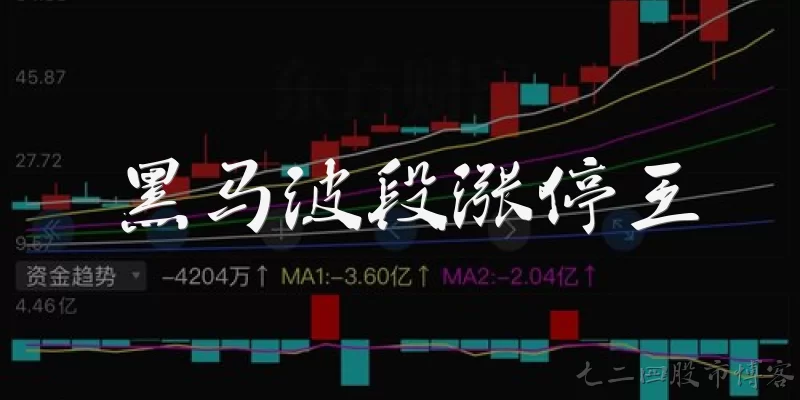
Dialogue about
Common scenarios of "Dark Horse Wave Limit-Up King"
【Stock Analyst】 Hey everyone, welcome back to the channel! Today we're diving deep into a trading strategy that's been making waves: the 'Dark Horse Wave Limit-Up King'. This isn't just about catching a single limit-up; it's about identifying a specific pattern that often precedes a series of explosive moves.
【Retail Trader】 I've heard the term 'Dark Horse' thrown around, but what exactly makes a stock a 'Dark Horse Wave Limit-Up King'? Is it just any stock that hits the limit-up?
【Stock Analyst】 Great question! No, it's much more specific. The 'Dark Horse' refers to a stock that has been consolidating quietly, often overlooked, and then suddenly shows a strong bullish signal. The 'Wave' indicates that the move comes in waves—typically a first limit-up that breaks out of consolidation, followed by a pullback, and then a second wave that's even stronger.
【Retail Trader】 So it's like a two-stage rocket? What are the key technical indicators to spot this before the first limit-up?
【Stock Analyst】 Exactly! Key indicators include: 1) A period of low volatility with decreasing volume, 2) A sudden spike in volume on the breakout day, 3) The stock closing at or near the limit-up price, and 4) Often a moving average convergence, like the 5-day crossing above the 20-day. But the real magic is in the wave structure.
【Retail Trader】 I've seen stocks that limit-up and then just fade away. How do you distinguish a true 'Dark Horse Wave' from a one-hit wonder?
【Stock Analyst】 The pullback after the first limit-up is crucial. In a true Dark Horse Wave, the pullback is shallow, typically not more than 10-15%, and volume dries up. It shows that sellers are exhausted and buyers are holding. Then, when the second wave starts, it often gaps up or surges with even higher volume.
【Retail Trader】 That makes sense. So you're looking for a 'flag' pattern after the first limit-up. What about fundamentals? Do you need a catalyst?
【Stock Analyst】 Fundamentals can help, but this is primarily a technical strategy. However, a catalyst like an earnings surprise, a new product, or sector rotation can add fuel. But the pattern itself is the core. The 'Limit-Up King' part means it often leads the market or its sector during that wave.
【Retail Trader】 How do you manage risk with this strategy? Where do you set your stop-loss?
【Stock Analyst】 Risk management is key. A common approach is to set a stop-loss below the low of the pullback period, or below the breakout day's low. If the stock breaks below that, the pattern is invalidated. Also, position sizing is important—never go all-in on one trade.
【Retail Trader】 Can you give a recent example of a stock that exhibited this pattern?
【Stock Analyst】 Sure, let's look at a hypothetical example: Stock XYZ. It traded in a tight range for weeks, then on day one, it surged to limit-up on triple the average volume. Over the next three days, it pulled back slightly on low volume, then on day five, it gapped up and hit limit-up again, starting a strong uptrend. That's a classic Dark Horse Wave.
【Retail Trader】 What timeframe do you usually use for this? Daily charts?
【Stock Analyst】 Daily charts are most common for swing traders, but some use 60-minute charts for intraday waves. The principle is the same: identify the consolidation, the breakout, the pullback, and the second breakout.
【Retail Trader】 Are there any sectors that tend to produce more of these Dark Horse Waves?
【Stock Analyst】 Small-cap and mid-cap stocks in hot sectors like tech, biotech, or new energy often show this pattern because they can move quickly. But it can happen in any sector during a bull market.
【Retail Trader】 What's the biggest mistake traders make with this strategy?
【Stock Analyst】 Chasing the first limit-up without waiting for the pullback. Often, the first limit-up is just the beginning, but if you buy at the top, you might get shaken out during the pullback. Patience is key. Also, ignoring volume—volume is the fuel.
【Retail Trader】 Thanks! I'll start scanning for these patterns. Any final tips?
【Stock Analyst】 Always backtest and paper trade before using real money. And remember, no strategy works 100% of the time. Combine it with other indicators and keep learning. Happy trading!